
Thursday, October 29, 2009

chickens feed me

How many of you have always wanted chickens? Maybe those of you who live in urban or suburban areas here in the United States have never really considered keeping a small flock of fowl right on your own property. Stop and ask yourself whether you’ve never considered the idea because you don’t really want anything to do with chickens or because you thought it wasn’t possible where you live? If it’s the latter you can toss out the notion that keeping chickens in town isn’t possible. It is very possible and you can start raising your own poultry as soon as you’d like.

Chickens can provide:

Hormone-free and antibiotic-free eggs(a wonderful source of protein) that taste better and are healthier than store bought eggs

Fertilizer for the garden in the form of manure from composted kitchen scraps.

Pest control of insects and grubs.

An excellent source of healthy meat for your table.

Wonderful companions.


For several years I fondly looked forward to the day when I could move to a home outside of the city where I could do all the things I’ve want to do for so long. With more room I could garden, grow fruit trees, start a compost pile and yes, raise chickens. Then one day I discovered something most recently phrased quite eloquently.

“wherever we go, the city, the country, the moon, we take ourselves with us. there is no heaven. i used to fantasize about living in a healthier place, one where i could ride my bike, for example. then, one day, i started riding my bike. now, without having fled or escaped to anywhere, i live in a place where i can ride my bike.” – heretic fig

And if he likes he can live in a place where he raises his own chickens. Chickens are incredibly easy to care for. I got my inspiration for raising urban chickens from Katy Skinner over at The City Chicken. She has put together a great site that not only answers most of the questions urban citizens might have concerning raising chickens in the city but she’s also got a gallery of chicken tractor photography that’s bound to inspire you to raise your own. This by the way is a chicken tractor, but we’ll get to housing in a bit.
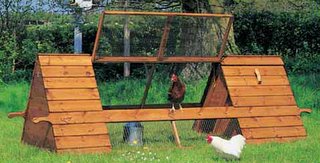

First it’s necessary to understand hens and roosters. Aren’t chickens loud most people ask? The answer is that the boy chickens (Roosters) are loud. They crow, especially early in the morning and are sure to annoy neighbors close by. I would not suggest raising roosters. Many municipalities don’t allow it anyway. Girl chickens (Hens) don’t make much noise. They do coo and occasional squawk when they get excited or are chased but on average they make much less noise than a dog. Some municipalities have adopted standardized zoning regulations that don’t allow livestock of any kind to be raised inside of the city limits. There are three approaches to dealing with this fact of location. The first is to lobby for a change in the law. The second is to attempt to acquire a personal variance. The third is to respectfully approach your neighbors with your intentions and if there are no objections quietly set up your chickens. A small flock of 3 or 4 hens will probably go unnoticed even in urban areas.


The next question most people ask is about how I get eggs if I don’t have any roosters. The answer is that chickens lay eggs regardless of whether or not there is a male around to fertilize the egg. The vast majority of the eggs you purchase in at the grocery store are unfertilized. If given some thought most people prefer the idea of eating an unfertilized egg.


Housing for your flock can be accomplished by building a chicken tractor (or chicken ark in the UK) a mobile, bottomless cage system that works well for housing your chickens. This will contain and protect your chickens while providing them with a humane and even enjoyable home. Chickens need a minimum of about 2 square feet of covered area to protect them from the elements. If you want eggs it’s best to provide a nesting box for the chickens to lay eggs in. They will make their own nest in the absence of a box. They may even lay their eggs out in the open but I think they appreciate the box. Chickens need at least 8 square feet of outdoor area. Technically they can survive completely indoors. This is how they’re raised in commercial operations. But I think you will have happier chickens if they get a little running room. They love to scratch and strut. Even in an urban environment chickens do face threats in the form of predators. Neighborhood dogs, raptors and even raccoons. The chicken tractor helps to ensure their safety. And they come in all shapes and sizes.

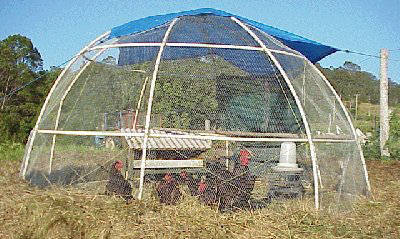
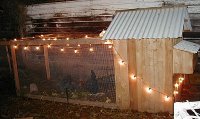
They even come in fashionable varieties.


Most people don’t realize chickens can fly. If you don’t provide them a home to sleep in at night they will often fly up into the safety of nearby trees. These trees may or may not be on your property. This could cause conflict with neighbors and is another reason to provide your chickens with a home. You can clip their wings to keep them grounded. This is accomplished by spreading one wing and cutting off the ends of the feathers. You don’t cut back very far so it doesn’t hurt the chicken. It just throws off the balance of flight and causes the chicken to crash if it tries to take to the air. Regardless of how permanent or how mobile you make you chicken housing structure it’s a good idea to provide the chickens their own abode.


You will need to provide your flock with a supply of water. The container will need to be cleaned periodically. A helpful hint is to tie the water container several inches above the ground. This will keep debris from flying into the water as the chickens scratch about. That means you’ll only have to scrub it when you change the water- once a week or so depending on the weather. I keep an old dish scrub brush next to the outdoor faucet for this purpose. You will also need to supply your chickens with food. Chickens will eat just about anything from your kitchen. They love table scraps and unlike dogs they prefer veggies. I feed them leftovers (they love spaghetti, think worms) and also any sort of grain or fruit I discard. Chickens are omnivores and will eat meat. I’ve watch them chase and eat crickets. They also love to scratch for grubs and bugs. They’re a great addition to the pest control division of my garden. I do refrain from feeding them leftover chicken. I bet they’d eat it but it just doesn’t seem right. I do mix their table scraps with feed I purchase from a farm supply store especially in the winter. I mix it myself to include chicken pellet feed, scratch grains and a small amount of crushed oyster shells. Sometimes I put it in a food container designed for chickens. Often though I just spread it on the ground in their outdoor area. They seem to enjoy scratching through their food.


All in all they work well as an excellent way to rapidly compost the organic material coming out of my kitchen. The manure the chickens generate is excellent fertilizer for the garden. Chicken droppings must be composted before they are used in the garden. If not they’ll burn the plants. I accomplish this by using a layer of leaves collected in the fall to line the interior of their structure’s outdoor area or chicken run. During the fall, winter and early spring I leave the chicken tractor in roughly the same spot. Every so often I rake up all the leaves, chicken poop and loose soil from the chicken run. I pile this material in a sunny spot and let it compost, replacing the layer of leaves in the chicken tractor. By time I’m ready to plant my garden I‘ve got excellent compost.


I do let the chickens roam loose in the backyard when I’m around, especially in the warmer months when there’s plenty of grass and insects for them to eat. During this time of year they mainly feed themselves during their “pasture time”. I do have a fence that encloses most but not all of my property. We do get the occasional animal that wanders into the area but the chickens are quick to run to their home at the first sign of danger and I seldom leave them to wander if I’m not close by. Rarely do I find the chickens venturing more than 100 feet from their home. As it gets dark I don’t even have to round them up. They make their way back to their tractor all on their own.

Chickens do need protection in the form of shade from hot summer days. The amount you provide will depend on your climate. Likewise you will need to provide a heat source in the winter if you live in a cold region of the globe. Chickens do fine down to the freezing point. At that temperature they can experience frost bite. My rule of thumb is to supply heat in the form of a light bulb to ensure the interior of their home never falls below 40 degrees Fahrenheit. The light seems to help promote winter season egg laying.


Chickens will begin laying eggs 4 and 8 months after hatching depending on the breed. During the first year of egg laying the chickens will be most prolific, laying almost one egg per day in prime circumstances. This does depend again on the breed. There are many different types of chickens. Do some investigating to determine which you would like to raise. There are even dwarf chickens or bantams that are smaller and therefore more appropriate for undersized backyards.


I must mention the Avian bird flu. It has not shown up in migratory birds here in North America. The virus spreads from wild fowl to domestic birds through interaction and then spreads to humans through direct contact. IT CAN BE EASILY AVOIDED by not allowing your birds to come into contact with wild, migratory birds. For most urban or suburban dwellers this is easy to do. I have never had a flock of wild geese land in my yard. The chicken tractor would ensure that the already unlikely contact between my birds and wild fowl doesn’t occur. The second layer of precaution is proper handling of the birds. Recently children in the country Turkey were infected with Avian flu after playing with severed chicken heads. This is not a good idea. In fact it’s smart not to handle your birds very often and to always wash your hands thoroughly after contact with them. The chances of getting sick because you raise chickens are minuscule. Most of what is covered in the mass media is fear mongering but you probably know that already.


I don’t cover the butchering of chickens to provide a meat source because I am a vegetarian and don’t have any experience in the matter. The resources provided at the end of this post will make available that information.


To end on a lighter note I’d like to briefly discuss brooding chicks. This is an exciting experience as you bring home your baby chicks and care for them until they’re ready to live outdoors in the home you provide. Spring is a good time of year to acquire your chicks as they are extra susceptible to cold until they grow fully formed feathers. You can inquire locally at farm supply stores. Some will sell chicks usually around Easter. If not they may know of local sources maybe even local farmers who will sell or trade for chicks. You can also buy them from hatcheries by mail order. The biggest problems will be the minimum purchase most companies require. Most backyard chicken owners don’t need 30 chickens! Persistence will award you with a reliable source. Many suppliers will be unable to tell you if you are purchasing hens or roosters. If this is the case you should plan on 50% of each. Make plans ahead of time on how you will humanely handle your roosters if you can not keep them. Often you may find people further out of town willing to adopt your roosters. Try Freecycle for giving them away as well. Before you get your little darlings home you’ll want to have their temporary home set up. You’ll need to get a container, the large Tupperware type works well. Use newspaper as a lining. This will allow you to clean up droppings easily. Some people have mentioned problems with wet newspaper sticking to the chicks but I haven’t had this problem. Next you’ll need a light bulb that you can adjust so it hangs lower or higher. A stronger bulb works better and have a spare on hand. You’ll need a container for food and a container for water. You can purchase metal containers for each purpose that screw on to regular mason jars. These work best at keeping the chicks and chick poop out of food and water. You can as always improvise. Special chick food can be purchased from your chick supplier, a feed store or online. While you’re buying get some chick grit. This will supply the chicks with the small stones they need to aid in digestion. Bring the chicks home as soon as possible if shipped by mail. Adjust the height of the bulb, their heat source. If it’s too low the chicks will get hot and move away from the bulb. If it’s too high the chicks will get cold and cheeep (complain) from underneath the bulb. You should start at 90 degree Fahrenheit and decrease the temperature by 5 degrees each week. The chicks will let you know (cheeep cheeep!) if you mess up. After about 6 weeks they’ll have most of their feather (depending on breed) and can be moved to an outdoor home depending on the weather and how weatherproof you’ve built their permanent home. A final note, be sure to check the chicks for poop build up on their underside. They can “paste up” and block waste removal. This can cause obvious problems.
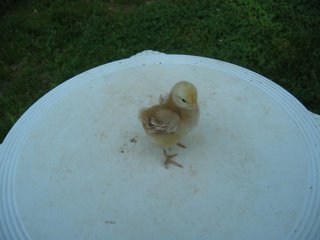
baby Ubie

All in all I think those willing to try raising backyard chickens will be please with the experience. What a wonderful way to provide food for yourself, fertilizer for you garden, pest control for your yard and to enjoy the company of intelligent and amusing creatures.

Best of luck.

The City Chicken
Chicken Encyclopdeia
Mad City Chickens
The Urban Chicken
Organic Living The Urban Chicken Part Three
Backyard Chickens
McMurray Hatchery
Brown Egg Blue Egg List of Hatcheries
Show Your Pride Urban Chicken Farmers!

Wednesday, October 28, 2009

FRESH the movie screening in Charlotte @ CPCC

I'll be on a discussion panel to follow the screening of Fresh the movie at Central Piedmont Community College in Charlotte, NC on November 5, 7:30 p.m. in Tate Hall, CPCC Central Campus.

Check out the trailer.


More info here.

Tuesday, October 27, 2009

artificial snow to combat drought


is there no problem human beings can't "fix"?!
Chinese meteorologists covered Beijing in snow Sunday after seeding clouds to bring winter weather to the capital in an effort to combat a lingering drought, state media reported.
whole story here

coming to a drought near you.

Friday, October 23, 2009

"we're entitled to it."

“They’re opening them (oil fields) up to other companies all over the world … We’re entitled to it,” Pickens said of Iraq’s oil. “Heck, we even lost 5,000 of our people, 65,000 injured and a trillion, five hundred billion dollars.”
Tell me again about how our invasion of Iraq wasn't about oil. Tell me how it was about Geppetto's WMDs or about how Saddam Hussein was really Osama's long lost brother or better yet how it was about liberating the Iraqi people.

Pickens says U.S. firms 'entitled' to Iraqi oil

Thursday, October 22, 2009

Design Project One :: A Courtyard Garden

So it makes sense that the best way to start any design project is to begin with a some idea of what you want to accomplish and you can do that with a list of questions. The next step is to take an inventory of what you have at hand. That will be the subject of today's post. We're going to Sharon's house or more specifically to the courtyard just outside her kitchen to create a base plan. You can follow along and create a base plan for your property.

Before we get started you'll grab a few items:

1. A pencil, some paper and a few coloured pencils or crayons if you have them. I highly recommend graph paper. You can download some by clicking here.

2. A measuring tape

3. A camera. This isn't absolutely necessary but a great help.

Begin by sketching your area of focus. If you intend to create a master plan for your entire property you'll probably want to start by sketching parts of the property and combining those sketches later on.

At this point don't try and be exact. Just measure and draw dimensions- lengths and widths relative to each other. For example if the driveway extends about one car length past the garage draw it that way. We'll refine these later so don't get hung up on getting it exactly right the first time. Here's a (refined) sketch of the courtyard we're using just as an example. At this point just get all the major elements: hard surfaces, walls, doors and windows down on paper. This is what the coutryard looks like in simple shapes.

Use colour to better define certain areas if that helps.

You're probably going to redraw this several times so don't get hung up on doing it over and over. Each base map will be better than the previous. Measure all the distances you can to help better refine the plan. Mark those dimensions on the plan. Then redraw it to better represent the accurate distances.

Now label all of the physical items you think relevant to your plan. Be sure to include existing plants. Include cardinal directions- North, South, East and West.


Now add notes about site features. These might include activities, persistent problems, great views, the place where the cat always sleeps, etc. This is where the answers to your questions start to merge with your base plan. You might want to take pictures for a record of what some of these site features look like. This might make redrawing the plan easier too.

The key to creating a successful base plan (and I know I've already mentioned this but it really is important) is to realize that you are going to redraw this thing many, many times before you get it exactly as you want it. Think of it as a living document that is going to change throughout the process, not a perfect picture of what you have now or plan to create in the future.

The graph paper I mentioned above can help with getting the dimensions drawn more accurately. Let one square represent a unit of distance. 1 square = 1 foot for example. If you find that doesn't give you a big enough sheet of paper try 1 square = 2 feet. This would mean drawing a 10 foot long wall using 5 blocks. If you still don't have enough room try 1 square = 5 feet. Now that 10 foot wall would only be 2 blocks long on your base plan. Eventually you'll find a scale that will work.

Next we're on to basic design. First we'll use the answers to our questions to put in place hardscape elements like new paths.


Then we'll add key elements; in this case potential sites for a trellis.


Lastly we'll begin to add plant material in general terms.


This plan is be no means complete. From here we would make a final decision about the location of a trellis, we would research keyhole gardens and decide about that too. We would also refine the plant material to include specific varieties that meet the requires described at this stage of the plan. The more complete the plan, the more likely we are to save time, money and energy. But the plan will change as your circumstances change. I hope this intital design project helps to show you how to create a base map and how to begin to make design decisions based on the needs and wants of your situation.

Aaron

farming where you are

On this typical, suburban street there's a space directly contiguous to the curb that creates distance between the whizzing cars and the relative safety of the sidewalk. It's a strip of grass seven feet wide.

It is maintained by a homeowner who uses gasoline made from petroleum to mow it short, and nitrogen fertilizer made using natural gas to keep it growing tall. Weeds are kept under control by using pesticides that wash into the gutters and down the storm water system into creeks where they pollute the water supply of both humans and all other creatures down stream. The lots on this street are 100 feet wide creating 700 square foot green strips in front of each home. John Jevons, states that it's possible for even a modest farmer to raise 200 pounds of potatoes per year in a 100 square foot area. That's a possible 1400 pounds of potatoes per house. At 330 calories per pound that's a total of 462,000 calories or 45% of the calories necessary to sustain the average teenage male for entire year. If he really likes potatoes.

It appears possible if you live on this street to reduce the amount of gasoline you use, reduce the amount of air pollution your dirty lawnmower belches out, reduce the about of natural gas used to make commercial fertilizers and reduce the amount of chemical pollutants in our water system all while growing almost half the calories your son will need for a year in an area that is not consider arable. I'm not really suggesting that this specific part of your plot is the best place to start actively cultivating land currently considered unfit for raising food. Or that man can live on potatoes alone. Maybe just the idea of starting to grow food in your front yard flower bed is enough (and you're going to want to add in some beans and tomatoes) but it does begin to suggest that our current definition of where we can grow food is in need of an update.

Typically we describe land capable of supporting food production as arable. But what is arable land? Of the 57 million square miles of dry land on Earth, approximately 12 million square miles, or 21%, are considered arable by traditional standards. The inverse term, Unarable, applies to the rest of the surface of the planet; hose areas that aren’t typically thought of as able to support food production. Typically these areas are too cold or too hot; too wet or too dry; too shady or too rocky or too steep for traditional agriculture. There it is again, “traditional agriculture.” What does that mean? Typically agriculture is defined as the systematic production of “food, feed and fiber” using domesticated plants and animals. Humans have been doing it for 10,000 years with varying degrees of success. Recently though the cyclic processes that governed this way of harvesting from nature have been replaced by a linear processes that substitute hydrocarbons for human & animal labor as well as nutrient recycling. We human beings have been experiencing a temporary vacation from the cycles that sustained us for thousands of years. And as a result we’ve paid little or no attention to the knowledge base necessary to do so. We’ve become complacent because of our cheap, abundant energy; paying no real attention to the idea that careful stewardship of the land is the only real way to ensure long term thrival of our species.

But now I’ve gone off on a tangent. I was talking about arable land and “traditional agriculture.” Far from being a non-traditionalist, I think the best place to start when considering our food future is to look back at history and learn the lessons it has to teach us. After all, the use of hydrocarbons to replace cycles with linear processes is a rather recent development. So how did humans get by before the age of cheap oil and natural gas in terms of raising plants and animals to eat? They grew food where they lived.

But how can an updated version of our attempts to farm change the way we think about where farming is possible, probable or even a good idea? The truth is farming is possible in many places not typically considered arable. The above example of an underutilized strip of grass next to a road way is but one example of space that can provide calories. Rooftops, patios, porches and even in our cars, people can used any and all available space to farm. It seems to me that any attempt to promote farming or the growing of one’s own food must examine an attempt to use existing resources for doing so. An old tire and some fallen leaves is enough to start growing potatoes on your patio. Ingenious ideas about using the trappings of modern life to contain soil and water in a sunny spot can yield food for you and your family. Arable land need not be only flat, rich soil in sunny spots located in temperate climates. Human ingenuity should be mined in an effort to expand where and how we grow our food.

Truck Farming - think it isn’t possible to grow food in your truck bed? ;-)

logsdon on the link between land and a job


From Gene Logsdon,
If you have some land, even an acre, you have the means for making at least part of your income and in the process gain a more secure life. Surely that is what it means to “have a job.” Our society hasn’t endorsed that notion yet, but I think that we are evolving toward that kind of economy.

We are only beginning to recognize how many income possibilities that a little piece of land can provide. We know about market gardening but most of us do not yet appreciate its reach...

We all accept the fact that most of us must invest in a car to keep our jobs. I think the day will come when most of us will also invest in a few acres of land to keep our jobs.
One commenter said, "I always equate security with land." Amen to that.

Read the whole thing here.

Thursday, October 15, 2009

questions to ask and measurements you'll need


If anyone wants to participate in our garden planning design class, we have a couple of spots remaining. Email Sharon at jewishfarmer@gmail.com if you are interested. There will be plenty to follow along with here on my blog, and at Sharon’s website www.sharonastyk.com - note, not all posts will be crossposted, so if you are interested, you’ll want to track both sites.

Also, if you are registered for this course and HAVE NOT received information about registering for the discussion group, please email Sharon ASAP, so we can get you set up.

Ready, Set, Go!


Questions to ask yourself before designing your garden.

What would you like to achieve on your property in terms of the landscaping of your home and its ability to feed you? This is the time to dream big and long term.

What is your timeline- can you make changes quickly or do you plan to make changes over several years?

How much money do you plan to dedicate to initial changes?

How much money can you dedicate on a monthly or annual basis?

How much sun do you get on your property? It helps to think in terms of number of hours of directly sunlight between March and November and think in terms of the different areas of your property.

Are you willing to remove trees to increase the amount of sunlight?

What is your source of water if irrigation becomes necessary? Can you harvest rain from your roof?

What is currently growing in your yard?

How important are the aesthetics of your yard to you? To your neighbors?

Are there neighborhood covenants, rules or regulations that are suppose to keep you from growing food or raising certain types of animals?

Will children be using the yard? If so what age and how many?

Will pets be using the yard? If so how many and what kind?

Do you use your yard for entertaining purposes?

Are there special activities like bonfires or hog racing for which you will need to set aside room?

Would you like to include fruit trees, bushes and edible perennials (plants that come back every year) in your landscape? If so how much room can you devote to these plants? (Remember trees are big and produce lots of shade. Shrubs can get big too.)

Do you plan to grow annual vegetables (plants you start from seed or transplant every year like corn and tomatoes) and if so how much room can you devote to these vegetables. By the way you’ll want at least 6, and better yet 8, hours of direct sunlight for this area.

How much time can you commit to your garden each week?

How much food, on a percentage basis based on your weekly menu, would you like to harvest from your yard?

Do you have physical limitations that would make typical gardening difficult for you?

How much help (significant others, reluctant in-laws, children, household pets pressed into the service of chasing away squirrels) do you have at your disposal?

How much experience do you with growing plants and gardening?

Do you have room to over-winter potted plants in your home?

Do you have sunny windowsill useful for starting seeds or growing sprouts?

What kinds of animals would you be interested in raising: chickens, turkeys, rabbits, goats, cows, pigs, sheep, llamas, bees, fish, or others?

What equipment do you own or could borrow? Think hand tools like shovels and rakes but also mowers and tillers.

Do you have natural sources of mulch available including baled straw, fallen leaves or grass clippings? How about cardboard (any appliance stores near by?)

Do you have room for outdoor containers on patios, decks or porches for growing food?

Do you anticipate a problem with animals such as rabbits or gophers visiting your garden and helping themselves to your produce?

Do you anticipate encountering soil contamination due to exterior lead paint or other chemicals previously used on your property?

Measurements you’ll need

The easiest way to get the measurements you’ll need to draw up a master plan for your yard will be to dig up a site survey of your property. You might have a copy tucked away in the material associated with the purchase of your home. If you rent your landlord, pleased that you’re improving the property, might offer you a copy of such a survey.

If you don’t have a survey handy don’t worry. You can take the measurements yourself. It’s best to invest in some graph paper. You can buy a pad or print some out. Here’s a source:

http://incompetech.com/graphpaper/

Using the graph paper to record your measurements and a tape measure or other measuring device, record the measurements of the perimeter of your house and any other structure on your property. Try to also measure the boundaries of your property. Often you can find pins or stakes or other marks that indicate property corners. If you can’t than your best guess will have to do. Try to measure the distance of your home and other structures from the edges of at least two property boundaries. This will help to more accurately place these structures.

Don’t expect to get this drawn up accurately on your first try. Typically you’re going to use several sheets of paper to record the measurements outside and then come inside to piece them all together for a base plan. By the way you can use the grids to represent a certain distance, say 5 feet. This will vary between properties because different scales will be necessary depending on the size of your property. Count the number of individual squares on the length and width of your paper and divide that number into the length and width of your property.

Or you can just try and get close in proportion to everything you want to show on your property. This should include all structures but also trees, shrubs, driveways, patios, decks, wells, existing gardens, walls, and anything else you see in your yard. When trying to measure and place these items accurately it helps to triangulate or take measurements to a certain object from several locations.

Again don’t try to get all this right on your first try. Get as many measurements as possible and then go inside and combine your efforts. It’s likely you’ll have to go back and remeasure a few elements but the more accurate your base plan, the less frustration you’re likely to encounter as you move forward with your plan. You don’t want to plan for and purchase 15 blueberry bushes only to come home and find that you only have room for 8 or that the play lawn you promised your children for purposes of Frisbee and football really has only enough room for a game of tag.

This base plan and the questions you’ve answered below will serve as a reference for the design process as we plan your garden. Keep them handy as we move along.

Thursday, October 08, 2009

garden planning and design

Swiss Chard

The radish photograph below was posted accidentally. I was trying to post it to my CSA's blog, Cold Water Creek Farms. If you've wondered why I don't post here as often that's the reason. I've jumped into full time farming at least for the summer and I've had forty family for whom I've been growing vegetables this year.

The radish image was a hit so I think I'll start posting more images from the farm.

There will be more action here however as Sharon Astyk and I are about to begin a 6 week Garden Planning and Design Class. Fall is actually the best time to get garden planning done so you're ready for the next growing season.

The goal of the class is for you to come out with a full design plan that takes into account the realities of your site and a strategy to implement your plan. The design plan will serve you over multiple years, and help you maximize your potential. Here's an example of a plan from our last class.


The class is offered online, asynchronously over six weeks. Sharon and I will offer new material, homework and new ideas on Thursdays, but will be available over the course of the week – you are free to participate as much or as little as you like – some people have tons of questions, others take a while to absorb information – both styles are just fine.

The class consists of several components – readings, which we’ll put up on our blog or link to through the discussion group, the discussion group where we pool our knowledge, answer questions and try to work through issues, homework, in which you’ll get the tools to build a site plan for your own space, and phone calls – each student gets one 15 minute phone consultation with one of us to answer any specific questions they have. The class begins on October 15, and runs until November 12.

The cost of the class is $180 and can be paid either with a check to addressed to Sharon Astyk at 43 Crow Hill Road Delanson, NY 12053 or by paypal to sharondownonthefarm@yahoo.com.

If you’d like to make a donation to our scholarship fund, 100% of which goes to making the class available to low income students who can’t otherwise afford it, you can do that as well at the same address.

Here is the syllabus:

Thursday, October 15: Sun, Soil, Water; Taking Measurements; The Project of Design, Meet Your Graph Paper ; Small Space and Urban challenges, Container Gardening, Getting Started,

Thursday, October 22: Soil Preparation, Perennial Plantings, Orcharding and Woody Agriculture; Permaculture, Seed Starting and Variety Selection, Calorie Crops, Beginning to Plan, Design Project 1 - A Courtyard Garden

Thursday, October 29: Transforming a City or Suburban Lot, Dealing with Zoning, Small Livestock and Polyculture; Finding More Land; Gardening Cheaply, Gardening in an Unstable Climate, Design Project 2 - A Suburban Yard

Thursday, November 5: Community and Garden; The CSA Model, Making Money, Children’s Gardens, Year-Round Gardening, Maximizing the Harvest Garden Design Project, 3: An Urban Farm - in Many Yards

Thursday, November 12: The CSA Model, Farm vs. Garden, Making Shade Productive, Vertical Gardening, Succession and Long term Planning, Deep Food Security.

Thursday November 19: Visions for the Future, Long Term Fertility, Larger Livestock, Becoming a Victory Farmer; After the Design Phase; Garden Design Project 4: A Larger Farm - In Smaller Pieces

You are invited to join in the fun.

Friday, September 25, 2009

Thursday, September 10, 2009

so when you say collapse...

This funny thing used to happen when my friend Todd and I discussed peak oil and energy descent back when we were just coming to grips with all of that. One of us would begin to explain a particular future scenario or perhaps a strategy to address that scenario. All of these conversations could be loosely described as plans to addresses to collapse of modern civilization. We were both a little more Doomer than we are today but even back then we recognized that “collapse” wouldn’t necessarily mean an overnight, madmax scenario complete with bunkers guarded by automatic weapons and the ubiquitous zombies coming to steal stockpiled spam. We felt there was a good chance things might get really bad, especially if the collapse was swift, but that “collapse” could mean many things.

At the beginning of these conversations we would usually have to define the situation, the extent to which the world and our lives had changed as a consequence of energy descent. For instance if Todd mentioned that he’d spent $600 stockpiling food over the weekend that would fall into the immediate collapse category in terms of response. If he wanted to have a conversation about integrating agriculture into community master planning (at the time we were working together as land planners) then I knew Todd was thinking about a collapse of the current paradigm of reckless land use planning not the sudden collapse of the western world.

Dmitri Orlov, author of _Reinventing Collapse_ wrote an excellent post some time back about the 5 stages of collapse. He defines them this way.

Stage 1: Financial collapse. Faith in "business as usual" is lost. The future is no longer assumed resemble the past in any way that allows risk to be assessed and financial assets to be guaranteed. Financial institutions become insolvent; savings are wiped out, and access to capital is lost.

Stage 2: Commercial collapse. Faith that "the market shall provide" is lost. Money is devalued and/or becomes scarce, commodities are hoarded, import and retail chains break down, and widespread shortages of survival necessities become the norm.

Stage 3: Political collapse. Faith that "the government will take care of you" is lost. As official attempts to mitigate widespread loss of access to commercial sources of survival necessities fail to make a difference, the political establishment loses legitimacy and relevance.

Stage 4: Social collapse. Faith that "your people will take care of you" is lost, as local social institutions, be they charities or other groups that rush in to fill the power vacuum run out of resources or fail through internal conflict.

Stage 5: Cultural collapse. Faith in the goodness of humanity is lost. People lose their capacity for "kindness, generosity, consideration, affection, honesty, hospitality, compassion, charity" (Turnbull, The Mountain People). Families disband and compete as individuals for scarce resources. The new motto becomes "May you die today so that I die tomorrow" (Solzhenitsyn, The Gulag Archipelago). There may even be some cannibalism.

The entire post is worth a read.

http://cluborlov.blogspot.com/2008/02/five-stages-of-collapse.html

Neither Orlov nor I believe that all 5 stages are inevitable. He says,

“Although many people imagine collapse to be a sort of elevator that goes to the sub-basement (our Stage 5) no matter which button you push, no such automatic mechanism can be discerned. Rather, driving us all to Stage 5 will require that a concerted effort be made at each of the intervening stages.”

This is important because I don’t want to give the perception that we’re all in a hand basket and headed for hell regardless of what we do. I certainly don’t believe that’s the case. But I think it’s important to recognize that because collapse is likely to play out over decades not within weeks, we need a temporal framework within which to consider our plans and actions and does so in the context of resource availability.

For instance, before or during the financial collapse might be a good time to insulate your home or at least work hard on that goal and you can postpone hoarding all that spam until you get that done. ;-) Learning a new skill is almost always useful but should you develop a local currency and open your own bank or take up blacksmithing? Both might be more useful depending on what collapse looks like in your future.

And it’s likely that there will be regional differences in terms of how collapse unfolds. We already experience regional differences that might make blacksmithing a more reasonable skill to pursue even today. Or there might already be a local currency in your area making that a project you need not start from scratch. It’s almost certain that financial collapse will affect some areas more severely than others. It’s important to consider how this timeline will vary based on where you live.

I’ve had several recent conversations with people who are trying to response to energy descent, climate change and resource depletion (and their financial repercussions) by adapting in place. The task can seem overwhelming. Trying to figure out what needs to be done and when- do I reinsulated the house now or use that time and money to jumpstart my gardening efforts. I find it helps to consider a timeline that thinks about how resources might be available in the future. It goes something like this.

[By the way I’m hoping Sharon can come up with less dorky names for my stages.]

Stage 1. Business as usual. Resources are available in roughly the same way they were at the turn of the century. Cheap electronic gadgets and pet food are purchasable at Wal-Mart. Food is still plentiful (even if the cost is putting it out of reach for more Americans) and electricity is still less than $0.20 per kilowatt hour. Gasoline is less than $4.00 per gallon. Home heating and cooling and cooking costs are not prohibitive for most.

Stage 2. Life gets expensive. Resources rise in price to the point that many more Americans cannot afford to keep a steady stream of consumer goods coming into their households. (The death of a cell phone for instance might mean looking for that old one buried in the junk drawer or buying a used one on Craig’s List or even going without) Food rises in price to the point that more American have gardens (at least small ones) than not. Some items like pineapples become unavailable or a luxury for the rich. Electricity doubles in price forcing those who can afford it to invest in renewables and others to start turning things off. At $5 or $6 per gallon, gas prices force less transportation of everything and everyone. Thermostats go down in the winter and up in the summer and people start plugging in lots of space heaters and window units.

Stage 3. Intermittent Service Disruptions. Some resources become unavailable through the regular channels- Wal-Mart runs out of calculators and pet food several times a month. Food becomes even more expensive and the diet of most Americans begins to change out of necessity. Chocolate and oranges show up as Christmas gifts not as everyday treats. Communities get serious about farming resources (or they don’t). Regional outages of electricity mean that it is not available 24/7 everyday of the year throughout the US. Water and natural gas outages occur as well. Gasoline at $10 a gallon means much less travel and serious relocalization efforts. Few new cars are built. Home heating and cooling throughout an entire house is no longer the norm in every household. Black markets get established for many more resources.

Stage 4. Resource Scarcity. Many resources aren’t available to most people especially those that come from far away. A serious salvage economy develops. Food production is largely local with regional support. Self provisioning becomes a must for most households. Food returns to the center of culture and community. Electricity is generated through home or community efforts if at all. Travel by car becomes a luxury of very few people because of the cost of fuel, with roadways degrading badly. Walking and biking become the norm (potentially rail services as well as horses are used again). Winters are cold and home heating is accomplished in large part by burning wood (sustainably?). Home cooling means taking off your shoes and cooking outside on the porch in the summer. Entirely new systems of trade are established.

I want to stress that I’m not suggesting a linear progression from top to bottom. Space aliens could arrive with cold fusion technology tomorrow or we could find ourselves in Stage 3 next Sunday. Or it could be argued that we experienced Stage 3 in a way here in the Southeast as we were without gasoline- actual empty pumps- after Hurricane Gustav ripped into us last year. It was temporary but it was a service disruption. I think using the mental framework of these categories is useful as a way to make plans in accordance to resource availability.

We have the current resource prices we are presently experiencing, in the future we’re likely to have greatly increased prices, we’re likely to experience periods where we flat out can’t get some stuff at least temporarily and eventually we’re likely to experience a world with fewer resources across the board. For me it’s helpful to consider what stage I’m planning for when my family makes decisions about how to adapt in place.

Wednesday, September 09, 2009

kreativ blogger award

Rob Hopkins nominated powering down for the Kreativ Blogger award earlier this month. I am honored to accept. Having received it, I must now do 4 things:

1. List 7 things I love

  • cycling
  • tea
  • the change of the seasons
  • huge old oak trees and their acorns
  • taking and looking at good photographs
  • growing food
  • writing and teaching

2. Link back to the person that nominated me- Rob Hopkins who runs the excellent www.transitionculture.org.

3. Choose 7 blogs to award as ‘Kreativ Bloggers’. My apologies to those I have failed to include.

4. Comment at each blog to let them know they’ve been chosen. [Done]


Thanks Rob.

Thursday, August 27, 2009

honey, peak oil means recycling our own urine


I’ve made the joke several times that losing my salaried job was really the only way I could take up full time farming and stay married. Its one thing to come home and say, “Honey I quit my job and I’m going to become a farmer.” It’s quite another to come home and say, “Honey I got laid off but don’t worry, I’ve got another job in mind- farming!” Sharon Astyk has written a really great piece for those of you who have partners that are giving farming a go. You can read it here.

http://sharonastyk.com/2009/06/04/so-you-dont-particularly-want-to-be-a-farmer-a-guide-for-the-perplexed-bothered-bewildered-and-outright-resentful-folks-hitched-to-a-wanna-be-farmer/

In a broader sense though making changes in our lives in response to a changing world means making those changes in the context of family and friends. I was talking to a recent high school graduate who understands the way the world is changing in a way that seems to escape most of the rest of American. Listening to her talk I found myself jealous of her freedom. She doesn’t have the commitments or responsibilities that many of us older folks have. She isn’t married, no kids, no mortgage, not even a dog. She has deferred college entrance for a year to spend time working on the sorts of projects that I think will come to the forefront of American life during the next decade in response to resources depletion, energy descent and climate change. And because of her situation she can throw herself into them head first. She can leap without looking.

For many of us it is the fear of change that holds us back but for those of us who live with the responsibilities and commitments of existing relationships like marriage or fatherhood, the fear of change is amplified by the concern of meeting the needs of our family and friends.

And I’m not just talking here about physical and fiscal needs although that is a concern. I’m dealing with those two in a serious way. My transition into farming isn’t exactly paying the bills at the moment. There is a learning curve involved with any new career. This isn’t exclusive to those of us who are making a radical career change with the post-peak carbon era in mind. All across the US, people are being laid off and coming up with all sorts of more conventional ideas about how to make money to support their families. But when new lifestyle ideas wander a certain distance off the beaten path, they invite skepticism or even criticism from family and friends. This can add a degree of stress to family life and social circles. You should see the reactions I get at dinner parties when I mention the fact that I’m a farmer. ;-)

I’m not one to spend an enormous amount of time concerning myself with the way others perceive me but still I admit to struggling at times with the choices I’m making; especially when the skepticism and criticism comes from those I love and trust. My wife is both very supportive and generally skeptical of wild ideas. Her support tends to quiet her skepticism but at times even she asks me how all this is going to turn out. “Will we be ok,” she’ll ask to which I can’t promise an answer. I don’t know what will happen any more than anybody else who hasn’t got a crystal ball. I believe that because I have a greater awareness of the big picture problems we’re facing I am better equipped to navigate the coming changes in the way of life here in the United States but awareness is no guarantee of success and so I have to say, “I hope so.”

Uncertainty seems to compel people to cling even tighter to that with which they are familiar. This makes change more difficult. It also means that coming to grips with need for change in my own mind isn’t enough to sail smoothly in a new direction. The idea that change is necessary and possible must be shared by those who inhabit the ships of our lives and are by default bound in the direction in which we are headed as a family. It isn’t easy to foster that idea or even a greater awareness of the problems we face in those I love but having made a few mistakes I thought I’d share them that others might avoid making them or perhaps mike make them less badly.

1. Go easy on gloom and doom. I remember announcing to my wife several years ago, having come to an understanding of peak oil, that I had discovered the world as we knew it was coming to an end. Not a smart move. What I was begin to understand concerning resource depletion was in fact important but I could have shared the news in a more, um, easily digestible way. I could have gone out to eat with my wife and told her about my concern with our unsustainable use of oil as a part of our overall dinner conversation. I could have asked if she wanted to watch a documentary like “The End of Suburbia” or given her a copy of the book _The Party’s Over_. The same is true of extended family and friends. Try not to overwhelm them on the first try.

2. Ask for feedback. Unless your crystal ball is firing on all cylinders it might just be possible that your partner/family/friends might have insights or ideas that could be useful. Even if you are in fact way ahead in terms of coming to grips with these changes or making plans for the future it will help to get buy-in from your family and friends if you fully include them in the evaluation and decision making processes. Decrees will not work.

3. Pay attention to what’s important to others. My wife was fully supportive of my intention to stop driving and start riding a bike. She was very supportive. It turned out that I could have made her very happy by in return investing in a new deck for our home. She wasn’t suggesting it from the standpoint of being able to spend more time outdoors in our warm climate when the house gets hot or making our home an even more enjoyable place that might reduce the need to go somewhere for a vacation. These are reasonable strategies even through the lens of response to energy descent and economic hardship. But investing in something that was important to her might have helped her to feel included in the decision-making process about how we shape our home. (By the way the deck goes in this winter)

4. Don’t turn to destructive coping devices. There was a period of time when I drank too much because I felt overwhelmed about what’s going on in the world. This isn’t a problem for me now but turning to an escape mechanism like alcohol will only make the situation worse. Trust me.

5. Have some fun. Ultimately many of the changes associated with resource depletion, energy descent and climate change will lead to a healthier, happier world. I’m not rosy-eyed enough to think that the transition won’t be difficult at times or that the future will be nothing but bliss but there advantages to a lifestyle of lower energy use. Share these positive aspects of change by painting an encouraging picture about what lies ahead. You’re much more likely to get the people you love to head with you in that direction.

Aaron