Tuesday, September 19, 2006

odds and ends (and beginnings)

Posting will be light this week. I'm headed to the Community Solutions conference on Thursday and currently my family is a bit under the weather here at the Acorn Ranch. Speaking of which acorns are coming into season. I just finished reading Stalking the Wild Asparagus in which Euell Gibbons estimates more calories have come from acorns during human history than from grain. Regardless of whether or not that's true it is that time of year, time to collect the prevalent little nuts. If you want to try your hand at cooking acorns check out Stalking or click here for a review of the process that includes another strategy- letting others eat them first.

For those of us looking for more information and inspiration concerning living more sustainably we have a new site to visit. Farmlet is the documentation of Kevin and Rebecca's journey towards a more self sufficient way of living. This couple is growing a 5 acre farm in northern New Zealand with the hopes of living a lower impact lifestyle. They also describe their project as "conscious" which I think hits the nail on the head. If only individual citizens of this planet (especially those in the U.S.) would take responsibility for the way they live. Farmlet has invited us to share in the process. I recommend you take them up on the offer.

Matt over at Fat Guy on a Little Bike has recently joined forces with Groovy Green but has his own stuff too. Born to be Wild or an even more recent post about his Visit to an Apple Orchard should serve as a good introduction. I'm looking forward to working with him.

Steve at Deconsumption revisits his Timeline for the Unfolding Crisis. More reading at peakoil where Ibon posts Losing Faith in Peak Oil's Transformative Power. And if you're looking for a more upbeat selection its happy 4 year farmiversary over at Pocket Farm. Me? I'm just happy to be feeling a bit better. What a wonderful new perspective always seems to reveal itself after my health is temporarily taken from me. That and I feel a little delirious.

Thursday, September 14, 2006

opec suspends production quotas

"In March 1971, the balance of power shifted. That month the Texas Railroad Commission set proration at 100 percent for the first time. This meant that Texas producers were no longer limited in the amount of oil that they could produce. More importantly, it meant that the power to control crude oil prices shifted from the United States (Texas, Oklahoma and Louisiana) to OPEC." (source)

U.S. crude oil production peaked in 1971. Now fast forward to the present and the most recent OPEC meeting in Vienna, Austria- Septemeber, 2006.

"Nigerian President Edmund Daukoru said that output quotas no longer applied. 'We stopped thinking of quotas a long, long while ago, and if the conference wants to return to quotas, we will do what is necessary to balance demand and supply against prices,' Daukoru said after OPEC ministers ended their formal meeting. Asked to clarify that this meant that there was no quota, Daukoru said: 'There is no quota, no, either up or down.'"(source)

When I read that OPEC has suspended production quotas I was highly surprised and a bit stunned. My wife asked me what it meant and I told her I didn't know. It is not however a decision that should be taken lightly. I found out about it from reading Jeff Vail and I share his sense of unknown implications. He says fasten your seatbelts. I'll add put on a helmet.

Monday, September 11, 2006

community solutions

The Third U.S. Conference on Peak Oil and Community Solutions is coming up. It's to be held on September 22-24, 2006 in Yellow Springs Ohio. Speakers include: Richard Heinberg, Julian Darley, Peter Bane,Vicki Robin, David W. Orr and many others. I'll be there as well. Endless discussion of peak oil statistics isn't of much interest to me. Nor is sitting around trying to guess the exact date of the arrival of the peak. The response of our communities to this coming era of human history, now that blows my hair back.

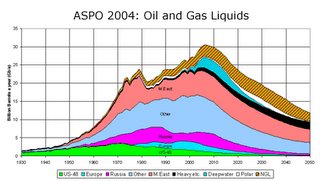
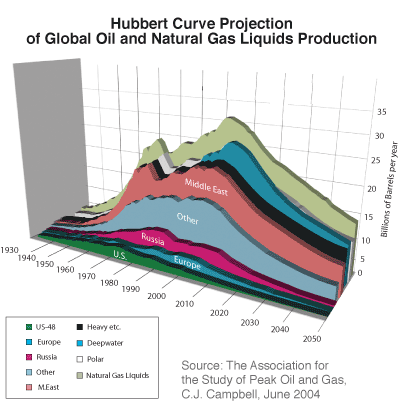
The truth is Hubbert's Curve is fairly simple to understand. We're nearing a point in time when less, not more petroleum energy will be available to human beings. We're not almost out of oil but we are about to begin experiencing a gap between what is available and what is being demanded by industrial society. The United States in particular has used oil energy to create a pattern of living that isn't sustainable without oil. There are no substitutes or combination of substitutes that will allow us to continue living in this manner indefinitely. It stands to reason then that we will have to change. That is what I am interested in.

I believe a return to mixed-use, walkable communities will go a long way towards reducing the amount of energy we need. It will also make it possible for us to leave the volatile Middle East, drastically reduce the amount of greenhouse gasses we emit into the atmosphere and get our overweight population out walking and talking again. I am not interested in arguing about whether or not the American people are willing to voluntarily make this change. The truth is it's inevitable. 90% of the world’s transportation runs on petroleum. When there is less oil available there will be less transportation of people and goods. Period. Those who can't afford the rising prices of anything shipped from far away will have to learn to get by with what is at hand. Relocalization is not an If but a When.

It stands to reason then that those communities who begin to focus on relocalization before it is a necessity will have a leg up on those who don't. Likewise individuals who recognize the need to live more locally will have a much better chance of thriving in a post peak oil world. Another reason I think relocalization is an excellent focus for our communities is the fact that it involves so many other issues. As Paula from Adaptation Blog put it, "Is Peak Oil awareness a prerequisite for relocalization efforts? I don’t think it is. Peak Oil is just one more reason why it’s necessary, one of possibly hundreds." I mentioned up above the removed dependency on the Middle East. I'm sure our men and women serving in the military would appreciate that and imagine if we could spend the 300+ Billion dollars we've spent in Iraq on education or maybe health care? Relocalization is itself a safeguard against terrorism. Large, centralized systems for distributing food or generating electricity are grand targets for those who would like to disable our country. Damage to small, decentralized systems would affect far fewer individuals and therefore decrease not only the impact but also decrease the lure of attack. Personal relationships with small, local businessmen, farmers, government officials, etc. would mean less control by large, global corporations looking to shirk responsibility for improper actions. More travel by means of muscle, either walking or biking, would result in physical and mental health improvements as well as helping to reestablish a human connection with nature. And let's not forget the improvements in air quality as less travel by motor vehicle would be necessary.

All of these are reasons to move away from globalization and towards relocalization. They represent as best I can see the most reasonable response to peak oil as well as the other problems facing industrial society. I have been and will be focusing more time on relocaliztion as a way to help myself, my family and my community prepare for the post peak world.

More information on the upcoming conference:
General Info / Speakers / Registration / Last Year's Highlights

September 11, 2007

What's even more troublesome than an unwilling victim is an unwilling person you're trying to help, and the fatal mistake of "9/11 truthers" is that they're trying to change the minds of people who don't want their minds changed. Ordinary people will not become powerful because it's too much responsibility. Almost everyone in the gang that ruined America and turned southwest Asia into a radioactive wasteland will retire to a huge house with servants, and most people will tell themselves whatever they have to, to make it safely to death without learning anything. - Ran Prieur


What do you really know about 9.11.2001 ?


Educate yourself but beware, Geraldo might call you a communist.

911Truth
Scholars for 911 Truth
Architects and Engineers for 911 Truth
Pilots for 911 Truth
Veterans for 911 Truth
911 Share the Truth
911 Truth Seekers
NY 9/11Truth
wtc7

Saturday, September 09, 2006

breakfast

Keaton had oatmeal for breakfast. And some peaches.

I collected food from my garden, a neighbor's garden, the woods and the hen house. Figs, grapes, blueberries, cantaloupe, cherry tomatoes, nasturtiums, a pear and an egg. Ummmm.

Friday, September 08, 2006

hard working pear tree

Just in time to introduce my daughter Keaton to eating fruit, this young pear tree is ready with its first crop. This heavily laden young tree has been bent over with the weight of fruit for some time now. We are grateful.

Thursday, September 07, 2006

don't go back to sleep

Today the price of oil is down to a 5 month low of $67 and change per barrel. This is probably due in large part to the recent announcement that Chevron has discovered an oil field deep below the ocean floor in the Gulf of Mexico. But before we all roll over and go back to sleep let's look at what was found.

"
Today the U.S. consumes about 22 MMbbls/d. By 2010, we'll likely be consuming about 25 MMbbls/d. At that consumption rate, those 15 billion barrels of crude would only give the United States a 21 month supply!"

You can read more from Luke Burgess on the topic by clicking here. If you prefer audio on the topic you can listen by clicking here and scrolling down.

Remember a peak in oil production doesn't mean we've run out of the stuff. It only means we've used about half of what exists. There will be future finds and they will be important. But let's not use those discoveries as an excuse to hit the snooze button and roll over for a few more years of ignoring reality. Let's use them as a way to delay the end of oil and respond reasonably to a future which will run on increasingly less fossil fuel energy. In other words this new find should not be taken as a sign that there is nothing to worry about but rather as a wake up call that oil is getting harder to pump. The new discovery is more than 5 miles below sea level!

Now is the time for transition not complacency.

Wednesday, September 06, 2006

Friday, September 01, 2006

happy labor day

I hope you get to take it easy and do a little swinging.

Thursday, August 31, 2006

a book review

Regularly it happens that in mid-conversation someone will ask me if I’ve read a certain book. Typically this person will go on to give a short summary of the book and then herald it as something interesting, something I should read. Sometimes however something completely different happens. After asking if I’ve read a certain book the person I’m talk with will give no details regarding the book; only pause as if to rearranging the direction of our discussion based on whether I have read the book or not. When this happens with the same book several times I know I need to read it. Such was the case with “The Last Hours of Ancient Sunlight.” I’ve been hearing about this book for several years but not in the typical way. This book belongs in another category. It seems to have such a profound affect on those who read it that they are sometimes forced to reorganize their conversations when speaking to those who have not. My whole review here...

Tuesday, August 29, 2006

the drain of what we knew

"our habit of self-destruction helps cut through arguments over whether ‘technology’ is good, bad, inert, whatever. technology is not a mythical beast over which we have no control, but an object of our creation - the embodiment of everything we covet and fear. clearly not every culture is stupid enough to roast itself. even in our own cultural past we have not always been this stupid."

Read more as heretic fig serves up an excellent helping of thoughtful commentary on our foolish attempt to impose our will upon the world. For thousands of years human beings lived in relative harmony with the environmnet around them. Now those of us in "developed" countries have discovered shortcuts around the cyclic processes that organized life before fossil fuels were exploited. When we began to view ourselves as apart from nature and then as the masters of nature we took a wrong turn that has led to the incredible wealth of a few and the extraordinary destruction of much of the rest of this planet's creatures and systems. Only now, as our mistaken direction is threatening our own human lives are we waking up to the potientially devestating effects of our actions. But now I'm bleeding over into my next post...

Wednesday, August 23, 2006

when will the peak perk?


The following was previously published by me over at Groovy Green. Also, I've reworked my comprehensive composting guide and put it up over on the front page of GG for those of you who missed it here at powering down early this year. Check it out if you're interested in making soil. Now for the main feature...

when will the peak perk?
by aaron newton

Jeffery Brown throws out a challenge to the main stream media.

“Who among you is going to have the courage to step forward and “break” the story that the lifeblood of the world economy–net oil export capacity–is now declining?”

Mr. Brown says, “I estimate that oil exports from the top 10 net oil exporters are probably now falling at a double digit annual rate.”

He’s an independent petroleum geologist from Dallas by the way; not one of them economists that thinks you can put dollar bills in your gas tank and drive to work. I once told two smart friends of mine, an engineer and a medical student, that physics trumps economics and they said I didn’t understand how the world works. I don’t. But I do think that as oil is physically less available “laws” of economics are going to spin on their heads. Just a little prediction for you this afternoon. Here’s one more. It will be obvious that we’ve peaked in oil production by the end of 2006. It’ll take a few more years, two maybe, for the most optimistic of oil cheerleaders to admit so (read up on the history of the peak in production in the U.S. - 1971). Then, suddenly everyone will be saying, “Yeah, of course we’ve peaked. That’s what oil fields do- Duh!” But by then the scurry to find the next source of fuel for our mobile lifestyles and our transportation dependent economy will be on in full force. My favorite are the news headlines that read, “How Will We Fuel The Cars of Tomorrow?”, or, “Is Ethanol The Answer?” No ethanol isn’t the answer. It’s only suggested as a part of the solution because Iowa is the first stop on the road to the White House. It seems very few people are stopping to consider ways of living that require less driving. Supply-side solutions will not solve the problem of the declining rate of petroleum production. In fact I’ll predict that they will cause more damage in the form of pollution and green house gasses and postpone the day when demand-side solutions will be seriously considered. The rush to liquefy coal, harvest oil shale and tar sands, and build new-cue-lar facilities will all be a very real part of our energy descent. But unless we are visited by aliens from outer space (and some think we will be) our politicians will remain tethered to the very industries that rely on a fossil fuel based economy. They will do more of the same; fight in the Middle East for the largest remaining oil deposits, refuse to address the idea of a shift in our economic paradigm and a change in our lifestyle, and continue to subsidize foolish supply “solutions” that will dirty our air, pollute our water and offer only a false hope that we can continue on our merry way. I wish I were cheerier about it but I’m not.

How then should those of us concerned about our dependency on dirty fossil fuels respond? Recently a friend wrote to me in an email, “I am repeatedly finding that there are lots of folks who would like to talk about the “environmental” movement but don’t want to actually take an aggressive stance in this area.”

My response was that there are two problems that I face in trying to affect change in the area of environment and energy. The first problem is the need to recognize that nothing I do to shape the minds of other people will be as effective as what I do to shape my own mind. And the second problem is to understand that there are plenty of well-meaning people who will do little to change the state of our world because they don’t understand the first problem. Without meaning to, they are spinning their wheels and they’ll spin mine too if I let them.

There are other people out there doing it, making real change. They serve me as both a source of inspiration and information. In the absence of physical neighbors who understand our environmental pickle we must, at this point, begin to build the lighthouses that will serve to illuminate a darkening world. We must have the foresight and resolve to do that which is unconventional. Frontyard gardens might be a source of neighborhood gossip now but the knowledge gained in growing them will turn into a valuable skill for the future. We must be willing to step forward in a new direction long before there are others to lead or even hands to hold. This is what I’ve come to believe.

I learned about peak oil a little more than two years ago. What followed was a life-changing rollercoaster ride during which my world view was refocused. Since then I’ve walked a path that meant learning about some of the incredibly foolish actions we’ve taken as a species in the recent past. My first instinct was to shout out to others so that they too might learn of our follies and help me steer the ship away from the rocks. I learned no one likes to be shouted at. Next I knocked at the door of those traditionally associate with championing the environment. But a mixture of politics, bureaucracy and/or an attitude of self-congratulatory smugness seemed to render many of them too ineffectual for me. Lastly I recognized what I said before, that I must change myself and be ready to help those others that wake up.

So here I am. Laying trails of bread crumbs and working diligently to better my model before it is needed by my community. I feel a sense of urgency but I’m no longer in a hurry. That would only lead to mistakes (and I make enough already). What will come will come. Maybe someone will accept the challenge Mr. Brown gave at the beginning of this posting. Perhaps tomorrow will be the dawning of a new age of awareness as the population at large learns of our predicament from the main stream media. Or more likely there are a few years ahead of us with relative calm as the problems of energy and environment compound. Then one day average Joe, his government representative and the National Association for the Societies of Environmental Activist Coalitions Against Global Pollution Efforts (NASEACAGPE) will be ready to understand.

When will it be time for a real change? Will I be ready?
Sunday, August 20, 2006

shared lately?

Have you told your friends and family about the coming shift in culture ready to take place as energy, specifically liquid and gaseous fossil fuels, decrease in availability and spin our way of living in a new direction? To put it another way, have you talked to your loved ones about peak oil, resource depletion, a turn from consumer-based society, your backyard garden, your new bike commute to work or even your general worry about how your children and your children's children might live? Robert did. Read his letter with a quick jump over here.

He awaits his friend Marcus's response...

Update: a response!

Saturday, August 19, 2006

eating carrots

This morning I wrote a short essay over at Groovy Green. Here's a bit of it.

"As a new way of life grows out of increased awareness about the state of our environment and our energy problems, we must remember that great change can’t be made without mistakes. I’ve made many. I’ll make more. Come and watch so you can learn. Share with me so that I might avoid the mistakes you’ve made. Together we can recognize the need to continue to walk and remind ourselves that the path is worthwhile even if it’s flawed sometimes. We can’t take a pass on progress in search of perfection."

You can read the whole thing, including more about Keaton eating carrots by clicking here.

Thursday, August 17, 2006

katrina advertiZing

More from Maria at Crew Creative Advertising below. Maria and her company are tapping the ever expanding blogosphere to advertise for the Discovery channel. I wrote a while back about her and the rise of indirect advertising over the internet. Read it here. OK Maria tell the folks what you want them to know...

Hello,

RE: Surviving Katrina

I just wanted to follow up on the "Surviving Katrina" Special that premieres on the Discovery Channel, August 27 at 9PM ET/PT.

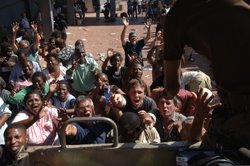
SURVIVING KATRINA covers the perfect storm of nature, science, politics and extreme human experience with a range of stories and interviews from all major aspects of the disaster, including Charity Hospital, the Convention Center and Superdome and with former FEMA director Michael Brown.

We have advance screeners available, please let me know if you'd be interested to write a review on your website and I can send you an advance screener of the special. [webaddress removed per her request but here's an image from website]

Also, visit our link below for access to our SURVIVING KATRINA assets page, where you will find a press release and images.

You are more than welcome to utilize any of the assets on the page, but please do not link directly to our server. Please keep me posted as assets go live on your site.

Please do not hesitate to contact me with any questions you may have. Thanks in advance for considering our request.

Thanks,

Maria

This post was designed to remind you that business is evolving and coming up with new ways to promote their products. Just so we all keep that in mind.

Will someone please watch this special and let me know what you think? Oh and I didn't make any money from this post; not one thin dime.

Monday, August 14, 2006

in town permaculture video

Andrew Millison put together this video about his urban permaculture project in Prescott, Arizona. Found it on Treehugger. Click the pic to watch.

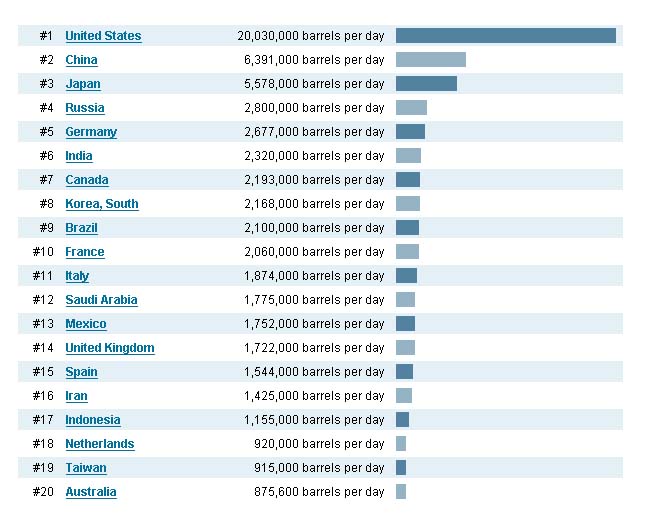
how dependent on oil are you?

As a nation, we're hooked. When you begin to understand in the global context the extent to which we are reliant on oil our behavior as a nation begins to make more sense. Just a reminder that those most dependent on a finite resource stand to lose the most when the production of that resource goes into decline. How long will we wait to wake up to this fact? How much pain will we have to feel before we shake off the propaganda of big oil, big auto and the other corporate interests who keep us convinced that we're fine- everything's fine. Stay tuned. I'm sure the answers to these questions will be revealed... eventually. In the meantime I suggest we all ponder where we personally would appear on a graph representing oil dependency among American citizens. How dependent on oil are you?

Graphs by NationMaster

Thursday, August 10, 2006

rocket science

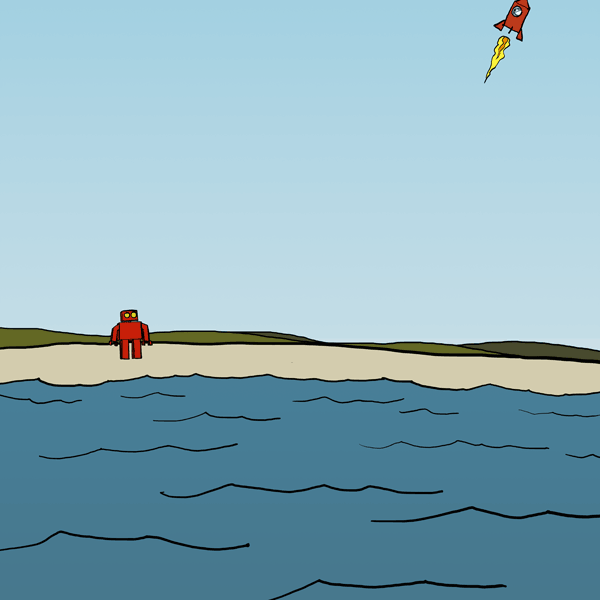
I think the discussion of peak oil has moved from its former existence as an arguable question (though there are still skeptics) through a period of anxious anticipation (are we there yet? are we there yet?) and has arrived for many of us as a realization that requires action. A growing mass has come to accept that the end of the oil age is upon us. This group is moving away from noisy discussions about if or when. Possibly out of fear, perhaps out of practicality, or maybe because this group is forward thinking, they are beginning to engage in serious discussions about how to deal with reality. All of this is a way to introduce what I think is an interesting idea.

PeakEngineer is a rocket scientist or more accurately a NASA engineer. He has established a new discussion called PeakOilDesign. It’s described as a,

“forum for discussing solutions for an organized planning and transition to post-Peak Oil life. This is a first stop for community organizers and those looking to become part of a community as oil-based life becomes increasingly difficult.”

He’s employing a systems engineering approach to plan for post petroleum life. I do recognize math as a language but using it to describe events or map plans of preparation can become static for me. I shy away from engineering and towards more organic types of training. In truth, even the organic world of plants and animals is made up of measurable data. And I could stand to pay more attention to the numbers if only as a way to track progress and facilitate efficiency so I’ll try and keep up. Design is after all the marriage of science and art in an effort to create. So take a look, offer your thoughts or at least check back from time to time and see what comes of it. The more ideas the better.

Wednesday, August 09, 2006

mixed bag

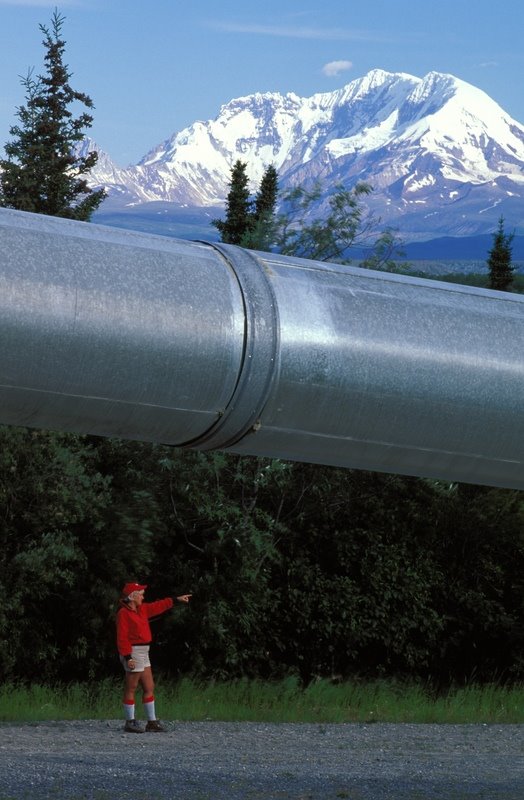
If you're interested in an alternative theroy concerning the recent shut down of the Alaskan oil pipeline Click Here.

If you're more interested in being hands-on productive and you'd like to save money and energy by insulating your hot water heater Click Here.

If you'd like to learn how to make fig jam (figs are in season- yum) then Check This Out.

If you want to read about the threat high gas prices pose to a suburban lifestyle Hit The Jump.

And if you have a hamster and a dead cell phone battery Try This One.

If you'd like to see a picture of Koda the dog, well, here you go.


I'm putting together several telephone interviews- trying something new. I'll let you know when they're done.

Monday, August 07, 2006

hold on


This from the New York Times Sunday edition,


"In a sudden blow to the nation's oil supply, half the production on Alaska's North Slope was being shut down Sunday after BP Exploration Alaska, Inc. discovered severe corrosion in a Prudhoe Bay oil transit line... That's close to 8 percent of U.S. oil production as of May 2006 or about 2.6 percent of U.S. supply including imports, according to data from the U.S. Energy Information Administration."

Some annalists are saying we can expect a $10 rise in the price of a barrel of oil. Others are saying the U.S. is well supplied and this will have little effect on price. If I were a betting man I'd go with the former. The real question however is how long this last will. No word on that from BP.

The volatility of the peak of oil is here. If you don't think so watch what a little corrosion in a pipe in Alaska does to the price of the fuel Suburban America is desperately dependant on.